
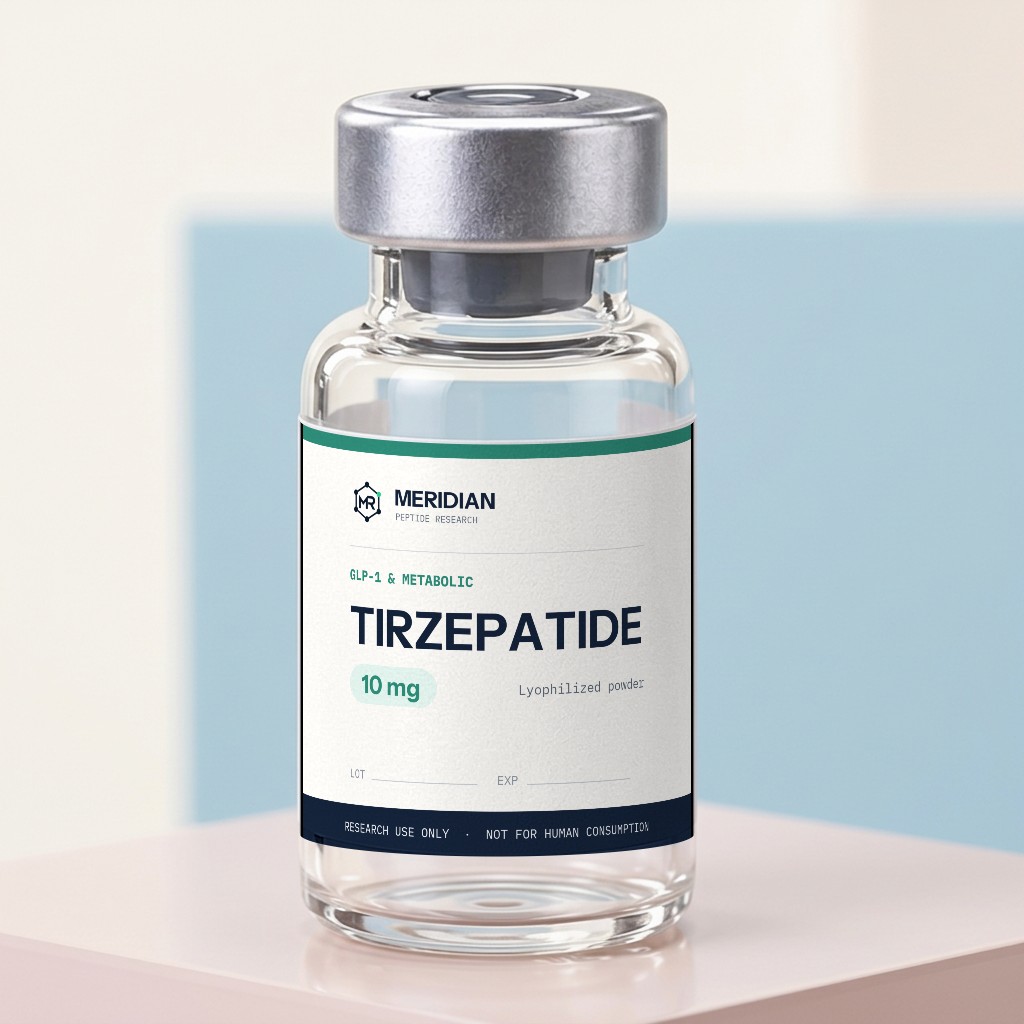
Representative image of the sealed vial. Label artwork and fill volume may vary by lot.
TIRZEPATIDE
LY3298176 · GIP/GLP-1 dual receptor agonist
A synthetic 39-residue dual GIP and GLP-1 receptor agonist peptide, supplied as a lyophilized powder for laboratory research.
- Documentation is lot-specific; request the record for the lot in stock
- Analytical methods and their limits are described on the testing page
- Lot lookup returns a result only where a signed report is held
- Supplied as a sealed vial for laboratory research use only
This material is supplied strictly for laboratory research. It is not a drug, food, cosmetic, or medical device, and it is not for human or veterinary consumption, diagnostic, or therapeutic use.
Overview
- Classification
- Acylated dual incretin receptor agonist, 39 residues
- Molecular formula
- C225H348N48O68
- Molecular weight
- 4813.5 g/mol
- CAS number
- 2023788-19-2
- Physical form
- White to off-white lyophilized powder
Research background
Tirzepatide is a synthetic peptide built on a glucose-dependent insulinotropic polypeptide (GIP) backbone and engineered to activate both the GIP and the GLP-1 receptor. It was described by Coskun et al. in Molecular Metabolism in 2018 under the identifier LY3298176. The design combined a GIP-based sequence with substitutions drawn from GLP-1 pharmacology, two non-natural aminoisobutyric acid residues to resist dipeptidyl peptidase-4 cleavage, and a C20 fatty diacid attached through a linker at lysine-20 to promote albumin binding and extend circulating half-life.
The founding paper reported in vitro receptor pharmacology showing full agonism at the human GIP receptor and partial agonism relative to native GLP-1 at the GLP-1 receptor, together with a signalling bias favouring cAMP generation over beta-arrestin recruitment at the GLP-1 receptor. The authors argued that this imbalanced profile, rather than simple co-agonism at equal potency, distinguishes the molecule from earlier dual agonists. Supporting data came from receptor-expressing cell lines and from rodent metabolic models.
Subsequent preclinical work has used the compound as a probe for incretin receptor crosstalk. Studies in receptor-knockout mice examined how much of the observed metabolic phenotype depended on each receptor individually, and islet and adipocyte preparations were used to dissect insulin secretion and lipolysis signalling. Willard et al. (2020) characterized the biased agonism at the GLP-1 receptor in more detail, reporting differences in receptor internalization kinetics compared with unbiased agonists.
There are meaningful limitations. The pharmacology of the GIP receptor remains contested in the literature: both agonism and antagonism at that receptor have been reported to produce broadly similar metabolic outcomes in animal models, and the field has not resolved the discrepancy. Species differences in the GIP receptor are pronounced, so rodent findings do not transfer cleanly. As with other albumin-binding acylated peptides, apparent potency depends on the albumin content of the assay medium, and results from serum-free and serum-containing systems are not directly comparable. Receptor-overexpressing cell lines used for potency work also carry receptor reserve that can mask partial agonism.
This material is supplied as a research reference standard. It is not a pharmaceutical product, is not manufactured to pharmacopoeial standards, and is not intended for administration to humans or animals in any context.
Analytical specifications
| Purity method | Reverse-phase HPLC, reported per lot on the COA |
|---|---|
| Identity method | Mass spectrometry against the theoretical mass |
| Endotoxin | LAL screening; result appears on the lot certificate where the assay has been run |
| Appearance | Visual inspection of cake integrity and vial seal |
| Regulatory status | Research reference material; not pharmaceutical grade |
Measured values are lot-specific and appear on that lot's certificate of analysis, not on this page.
Laboratory handling and storage
- Store sealed lyophilized vials at -20 °C, protected from light and moisture.
- Bring vials to room temperature before opening so that condensation does not enter the cake.
- Reconstitute gently down the vial wall. Vigorous agitation promotes foaming and aggregation in long acylated peptides.
- Use low-binding plasticware or a carrier protein for dilute working solutions to limit adsorption losses.
- Aliquot for single use; avoid repeated freeze-thaw cycles and log the lot number against each aliquot.
Certificate of analysis
No certificate is published on this page. Documents are lot-specific, and posting a report that does not match the vial you receive would be worse than posting nothing. Request the certificate for the lot currently in stock, or read how our testing program works and what each method does not detect.
References
- 1.Coskun T, et al. LY3298176, a novel dual GIP and GLP-1 receptor agonist for the treatment of type 2 diabetes mellitus: from discovery to clinical proof of concept. Molecular Metabolism, 2018.
- 2.Willard FS, et al. Tirzepatide is an imbalanced and biased dual GIP and GLP-1 receptor agonist. JCI Insight, 2020.
Frequently asked
What does 'biased agonist' mean in the published characterization?
It refers to a ligand that favours one downstream pathway over another at the same receptor. In the published work the compound favoured cAMP signalling over beta-arrestin recruitment at the GLP-1 receptor.
Is this material equivalent to a pharmaceutical product of the same name?
No. It is a research reference material for laboratory use only, not manufactured to pharmacopoeial standards and not authorized for any medicinal use.
Why is the reported potency at the GLP-1 receptor lower than native GLP-1?
The published pharmacology describes full agonism at the GIP receptor and partial agonism at the GLP-1 receptor relative to the native ligand. That asymmetry is a property of the molecule as designed.