
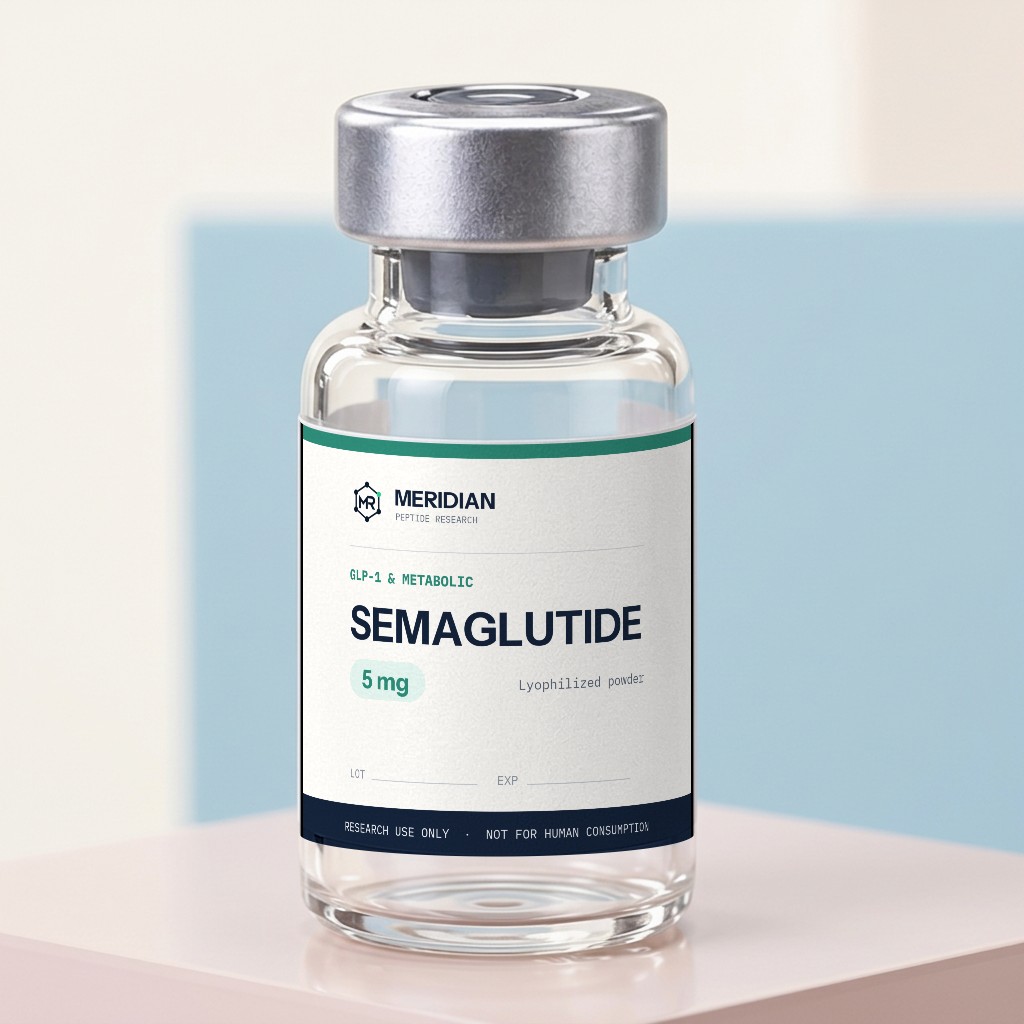
Representative image of the sealed vial. Label artwork and fill volume may vary by lot.
SEMAGLUTIDE
NN9535 · GLP-1 analogue, C18 diacid acylated
A synthetic acylated GLP-1 receptor agonist analogue, supplied as a lyophilized powder for in vitro and preclinical laboratory research.
- Documentation is lot-specific; request the record for the lot in stock
- Analytical methods and their limits are described on the testing page
- Lot lookup returns a result only where a signed report is held
- Supplied as a sealed vial for laboratory research use only
This material is supplied strictly for laboratory research. It is not a drug, food, cosmetic, or medical device, and it is not for human or veterinary consumption, diagnostic, or therapeutic use.
Overview
- Classification
- Acylated glucagon-like peptide-1 (GLP-1) analogue, 31 residues
- Molecular formula
- C187H291N45O59
- Molecular weight
- 4113.6 g/mol
- CAS number
- 910463-68-2
- Physical form
- White to off-white lyophilized powder
Research background
Semaglutide is a structurally modified analogue of human glucagon-like peptide-1. Native GLP-1 is cleaved rapidly by dipeptidyl peptidase-4, giving it a plasma half-life measured in minutes and making it impractical as a long-acting research or therapeutic agent. The design work that produced semaglutide, described by Lau et al. in the Journal of Medicinal Chemistry in 2015, addressed this with three modifications to the backbone and side chain: substitution of alanine at position 8 with alpha-aminoisobutyric acid to resist DPP-4 cleavage, a lysine-26 acylation carrying a C18 diacid via a gamma-glutamyl and short PEG spacer to promote albumin binding, and an arginine substitution at position 34 to direct acylation to a single site.
The 2015 paper reported receptor binding and cAMP potency data in cell systems expressing the human GLP-1 receptor, albumin affinity measurements, and pharmacokinetic profiles in minipigs, where the extended half-life relative to earlier analogues was the central finding. This combination of protease resistance and albumin binding is the standard explanation for the compound's duration of action, and the molecule has since become a common comparator in receptor pharmacology.
In preclinical work the compound has been used mainly as a tool for probing GLP-1 receptor signalling. Rodent and cell-based studies examined receptor internalization and beta-arrestin recruitment relative to G-protein coupling, insulin secretion in isolated islets, and central nervous system receptor distribution. Gabery et al. (2020) used labelled compound in mice to map access to brain regions expressing the receptor, reporting a distribution largely confined to circumventricular structures and specific hypothalamic and brainstem nuclei rather than broad parenchymal penetration.
Limitations relevant to bench work are mostly practical. Because the molecule binds albumin strongly by design, apparent potency in assays containing serum albumin differs from potency in defined media, and comparisons across published studies require attention to assay buffer composition. Receptor pharmacology data are frequently generated in overexpressing cell lines whose receptor reserve differs from primary tissue. Species differences in the GLP-1 receptor are well documented, so rodent results are not directly transferable across species without confirmation. Peptides of this size are also sensitive to adsorption onto plastic at low concentrations, which can distort dose-response curves if carrier protein is omitted.
This material is supplied as a research reference standard. It is not a pharmaceutical product, is not manufactured to pharmacopoeial standards, and is not intended for administration to humans or animals in any context.
Analytical specifications
| Purity method | Reverse-phase HPLC, reported per lot on the COA |
|---|---|
| Identity method | Mass spectrometry against the theoretical mass |
| Endotoxin | LAL screening; result appears on the lot certificate where the assay has been run |
| Appearance | Visual inspection of cake integrity and vial seal |
| Regulatory status | Research reference material; not pharmaceutical grade |
Measured values are lot-specific and appear on that lot's certificate of analysis, not on this page.
Laboratory handling and storage
- Store sealed lyophilized vials at -20 °C, protected from light and moisture.
- Equilibrate to room temperature before opening to avoid condensation on the cake.
- Reconstitute gently by directing solvent down the vial wall; do not vortex vigorously, as shear and foaming promote aggregation in acylated peptides of this size.
- For low-concentration assays, include a carrier protein or use low-binding plasticware — adsorption losses are significant at sub-microgram levels.
- Aliquot for single use and avoid repeated freeze-thaw cycles. Record lot number against every aliquot.
Certificate of analysis
No certificate is published on this page. Documents are lot-specific, and posting a report that does not match the vial you receive would be worse than posting nothing. Request the certificate for the lot currently in stock, or read how our testing program works and what each method does not detect.
References
- 1.Lau J, et al. Discovery of the once-weekly glucagon-like peptide-1 (GLP-1) analogue semaglutide. Journal of Medicinal Chemistry, 2015.
- 2.Gabery S, et al. Semaglutide lowers body weight in rodents via distributed neural pathways. JCI Insight, 2020.
- 3.Knudsen LB, Lau J. The discovery and development of liraglutide and semaglutide. Frontiers in Endocrinology, 2019.
Frequently asked
Is this material equivalent to a pharmaceutical product of the same name?
No. It is supplied as a research reference material for laboratory use. It is not manufactured to pharmacopoeial standards and carries no medicinal authorization of any kind.
Why does apparent potency vary between published assays?
The molecule is engineered to bind albumin. Free fraction — and therefore apparent potency — depends on whether the assay medium contains albumin and at what concentration.
What does the mass spectrometry result confirm?
That the observed mass matches the theoretical mass for the intended sequence and modification. It confirms identity, not purity, and it will not resolve every closely related impurity.