
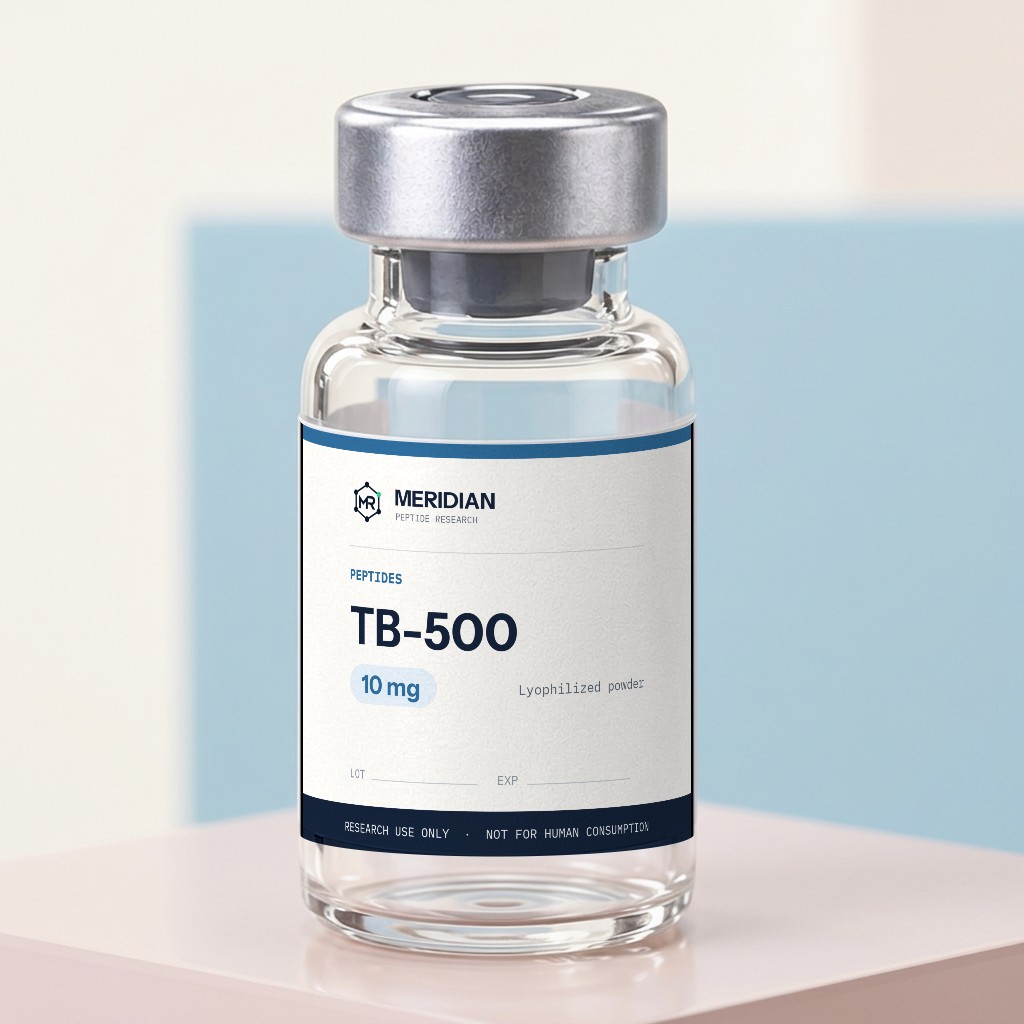
Representative image of the sealed vial. Label artwork and fill volume may vary by lot.
TB-500
Thymosin beta-4 fragment · Tβ4 (17-23) actin-binding domain · Ac-LKKTETQ
A synthetic peptide corresponding to the actin-binding region of thymosin beta-4, supplied lyophilized for laboratory research.
- Documentation is lot-specific; request the record for the lot in stock
- Analytical methods and their limits are described on the testing page
- Lot lookup returns a result only where a signed report is held
- Supplied as a sealed vial for laboratory research use only
This material is supplied strictly for laboratory research. It is not a drug, food, cosmetic, or medical device, and it is not for human or veterinary consumption, diagnostic, or therapeutic use.
Overview
- Classification
- Synthetic peptide fragment of thymosin beta-4
- Sequence
- Ac-Leu-Lys-Lys-Thr-Glu-Thr-Gln (actin-binding motif)
- Molecular weight
- 889.0 g/mol for the acetylated 7-mer; full-length Tβ4 is 4963.5 g/mol
- Physical form
- White to off-white lyophilized powder
Research background
Thymosin beta-4 is a 43-residue, naturally occurring peptide first isolated from calf thymus and later shown to be one of the most abundant actin-sequestering proteins in mammalian cells. Its best-characterized biochemical function is binding monomeric G-actin and regulating the pool available for filament assembly. The short sequence marketed under the name TB-500 corresponds to the central actin-binding motif of that protein; the two are not interchangeable, and much of the frequently cited literature concerns full-length thymosin beta-4 rather than the fragment.
Malinda et al. (1999), working at the National Institutes of Health, reported that full-length thymosin beta-4 increased keratinocyte and endothelial cell migration in vitro and accelerated closure in a rodent full-thickness dermal wound model. Bock-Marquette et al. (2004), publishing in Nature, described cardiomyocyte survival and migration effects in mouse cardiac injury models and proposed an integrin-linked kinase and Akt-dependent mechanism. Subsequent groups examined corneal and dermal injury models with broadly consistent directionality but variable effect sizes.
Work on the shorter actin-binding fragment is thinner. Several papers reported that the isolated motif retained a portion of the cell-migration activity seen with the parent peptide in culture, which is the primary rationale for its use as a research tool. Whether the fragment reproduces the full protein's behaviour in intact tissue is not settled, and studies that assume equivalence between the two should be read with that caveat in mind.
Clinical translation of the parent peptide has been limited. Ophthalmic formulations of thymosin beta-4 progressed into controlled trials for ocular surface conditions, and published results were mixed across endpoints. For the synthetic fragment specifically, there is no substantial controlled human literature.
Methodological limitations recur across this field. Many in vitro migration assays use scratch-wound designs whose readouts are sensitive to seeding density and imaging interval. Animal studies are often small and report a single time point. Because the fragment and the full-length protein differ substantially in size and in the number of interaction surfaces available, results obtained with one should not be attributed to the other without direct comparison in the same system. Investigators should confirm the identity and net peptide content of the material actually used, since the acetylated 7-mer and full-length Tβ4 are both distributed under overlapping trade names.
Analytical specifications
| Purity method | Reverse-phase HPLC, reported per lot on the COA |
|---|---|
| Identity method | Mass spectrometry against the theoretical mass |
| Endotoxin | LAL screening; result appears on the lot certificate where the assay has been run |
| Appearance | Visual inspection of cake integrity and vial seal |
| N-terminus | Acetylated |
Measured values are lot-specific and appear on that lot's certificate of analysis, not on this page.
Laboratory handling and storage
- Store the sealed lyophilized vial at -20 °C, protected from light and moisture.
- Equilibrate to room temperature before breaking the seal to prevent condensation on the cake.
- The peptide is water-soluble; add solvent slowly down the vial wall rather than directly onto the cake to reduce foaming and peptide loss at the air-liquid interface.
- Aliquot reconstituted material for single use and avoid repeated freeze-thaw cycles.
- Confirm which species your protocol requires — the acetylated 7-mer or full-length thymosin beta-4 — before substituting one for the other.
Certificate of analysis
No certificate is published on this page. Documents are lot-specific, and posting a report that does not match the vial you receive would be worse than posting nothing. Request the certificate for the lot currently in stock, or read how our testing program works and what each method does not detect.
References
- 1.Malinda KM, et al. Thymosin beta4 accelerates wound healing. Journal of Investigative Dermatology, 1999.
- 2.Bock-Marquette I, et al. Thymosin beta4 activates integrin-linked kinase and promotes cardiac cell migration, survival and cardiac repair. Nature, 2004.
- 3.Goldstein AL, Hannappel E, Kleinman HK. Thymosin beta4: actin-sequestering protein moonlights to repair injured tissues. Trends in Molecular Medicine, 2005.
Frequently asked
Is TB-500 the same as thymosin beta-4?
No. TB-500 commonly refers to a short synthetic peptide containing the actin-binding motif of thymosin beta-4, while Tβ4 is the full 43-residue protein. Much of the published literature concerns the full-length protein.
Why does the mass on the certificate differ from figures quoted elsewhere?
Because sources differ on which species they describe. Check the observed mass against the sequence stated on the certificate rather than against a general reference figure.
Does HPLC purity account for water and salt content?
No. Purity by peak area is separate from net peptide content. Gravimetric work should account for counter-ion and residual water.