
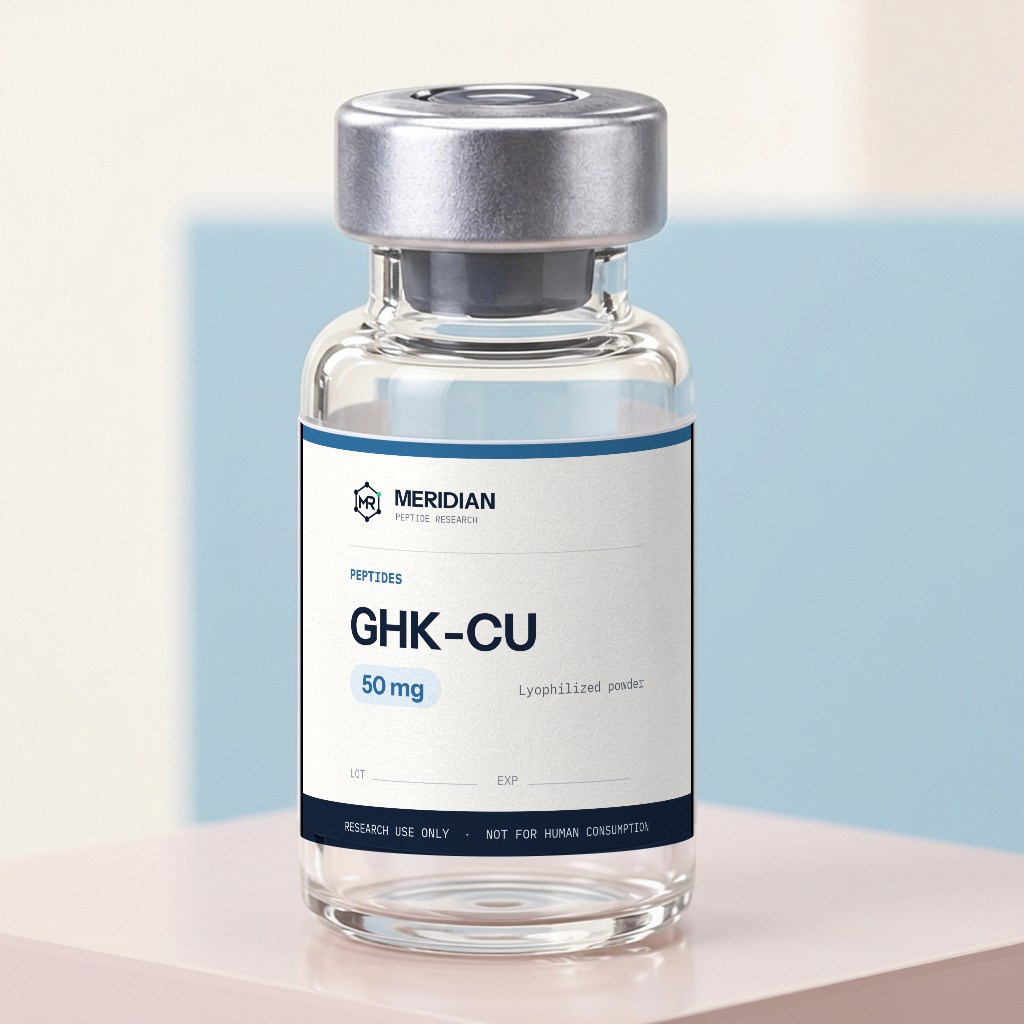
Representative image of the sealed vial. Label artwork and fill volume may vary by lot.
GHK-Cu (Copper Peptide)
Copper tripeptide-1 · GHK-copper · Gly-His-Lys copper complex
The copper(II) complex of the tripeptide glycyl-L-histidyl-L-lysine, supplied as a lyophilized powder for laboratory research.
- Documentation is lot-specific; request the record for the lot in stock
- Analytical methods and their limits are described on the testing page
- Lot lookup returns a result only where a signed report is held
- Supplied as a sealed vial for laboratory research use only
This material is supplied strictly for laboratory research. It is not a drug, food, cosmetic, or medical device, and it is not for human or veterinary consumption, diagnostic, or therapeutic use.
Overview
- Classification
- Tripeptide-copper(II) coordination complex
- Sequence
- Gly-His-Lys
- Molecular formula
- C14H24N6O4·Cu (complex)
- Molecular weight
- 340.8 g/mol for the copper complex; 340.4 g/mol for the free tripeptide
- CAS number
- 89030-95-5 (copper complex); 49557-75-7 (free peptide)
- Physical form
- Blue lyophilized powder or blue solid, colour arising from the copper(II) centre
Research background
GHK was identified by Loren Pickart in the early 1970s during work on plasma fractions from human serum, and was subsequently characterized as a tripeptide with high affinity for copper(II). The peptide-copper complex, rather than the free peptide, is the species most often studied, and the coordination chemistry is central to the reported activity: the histidine imidazole, the N-terminal amine, and the adjacent amide nitrogen form the principal donor set.
Cell culture studies through the 1980s and 1990s reported that the complex influenced fibroblast behaviour. Maquart et al. (1988, 1993) reported increased collagen and glycosaminoglycan synthesis in cultured fibroblasts and in rat wound-chamber models. Later work examined effects on matrix metalloproteinases and their tissue inhibitors, with reports of concurrent changes in both synthetic and degradative arms of matrix turnover, which the authors interpreted as remodelling rather than simple accumulation.
A separate line of work concerned gene expression profiling. Pickart and colleagues, drawing on the Broad Institute Connectivity Map dataset, reported that exposure of cultured cell lines to the tripeptide was associated with directional changes across a large number of transcripts. This analysis is hypothesis-generating: it describes correlations in a public perturbation dataset in immortalized cell lines, not verified mechanisms in primary tissue.
The complex has also been used as a copper delivery vehicle in coordination-chemistry and materials studies, where its stability constant and redox behaviour are the properties of interest rather than any cellular endpoint. In that context it appears in work on copper-binding assays, on peptide-metal spectroscopy, and as a reference ligand.
Limitations are significant. A large fraction of the widely cited literature originates with a small number of authors, several of whom have had commercial interests in the compound, and independent replication of the transcriptomic claims is limited. Cell-culture results depend strongly on copper concentration in the medium — serum-containing media already contain copper-binding proteins, and free copper is cytotoxic above modest concentrations — so control conditions that separate the effect of the peptide from the effect of delivered copper are essential and are absent from some older reports. Any experiment using this material should include a copper-salt control and a free-peptide control, and should verify the copper-to-peptide stoichiometry of the batch in use.
Analytical specifications
| Purity method | Reverse-phase HPLC, reported per lot on the COA |
|---|---|
| Identity method | Mass spectrometry against the theoretical mass |
| Appearance | Blue solid; colour is characteristic of the copper(II) complex |
| Endotoxin | LAL screening; result appears on the lot certificate where the assay has been run |
Measured values are lot-specific and appear on that lot's certificate of analysis, not on this page.
Laboratory handling and storage
- Store sealed vials at -20 °C, protected from light and moisture.
- The complex is water-soluble. Solutions are blue; a marked colour change can indicate copper loss or degradation and warrants re-analysis before use.
- Chelating agents in buffers, including EDTA and high concentrations of citrate, will strip copper from the complex. Check buffer composition before use.
- Include a copper-salt control and a free-peptide control in cell work so that peptide effects can be separated from copper effects.
- Aliquot reconstituted solution for single use; avoid repeated freeze-thaw cycles.
Certificate of analysis
No certificate is published on this page. Documents are lot-specific, and posting a report that does not match the vial you receive would be worse than posting nothing. Request the certificate for the lot currently in stock, or read how our testing program works and what each method does not detect.
References
- 1.Pickart L, Thaler MM. Tripeptide in human serum which prolongs survival of normal liver cells and stimulates growth in neoplastic liver. Nature New Biology, 1973.
- 2.Maquart FX, et al. Stimulation of collagen synthesis in fibroblast cultures by the tripeptide-copper complex glycyl-L-histidyl-L-lysine-Cu2+. FEBS Letters, 1988.
- 3.Pickart L, Margolina A. Regenerative and protective actions of the GHK-Cu peptide in the light of the new gene data. International Journal of Molecular Sciences, 2018.
Frequently asked
Why is the powder blue?
The colour comes from the copper(II) centre in the complex. Free GHK without copper is not blue.
Should the free peptide or the copper complex be ordered?
That depends on the experiment. Most published cell work used the copper complex; coordination-chemistry work sometimes starts from the free peptide and adds copper under controlled conditions.
Does the certificate report copper content?
The certificate reports the tests actually performed on that lot. If your protocol requires a verified copper-to-peptide ratio, contact us before ordering so we can tell you whether that determination is available for the lot in stock.