
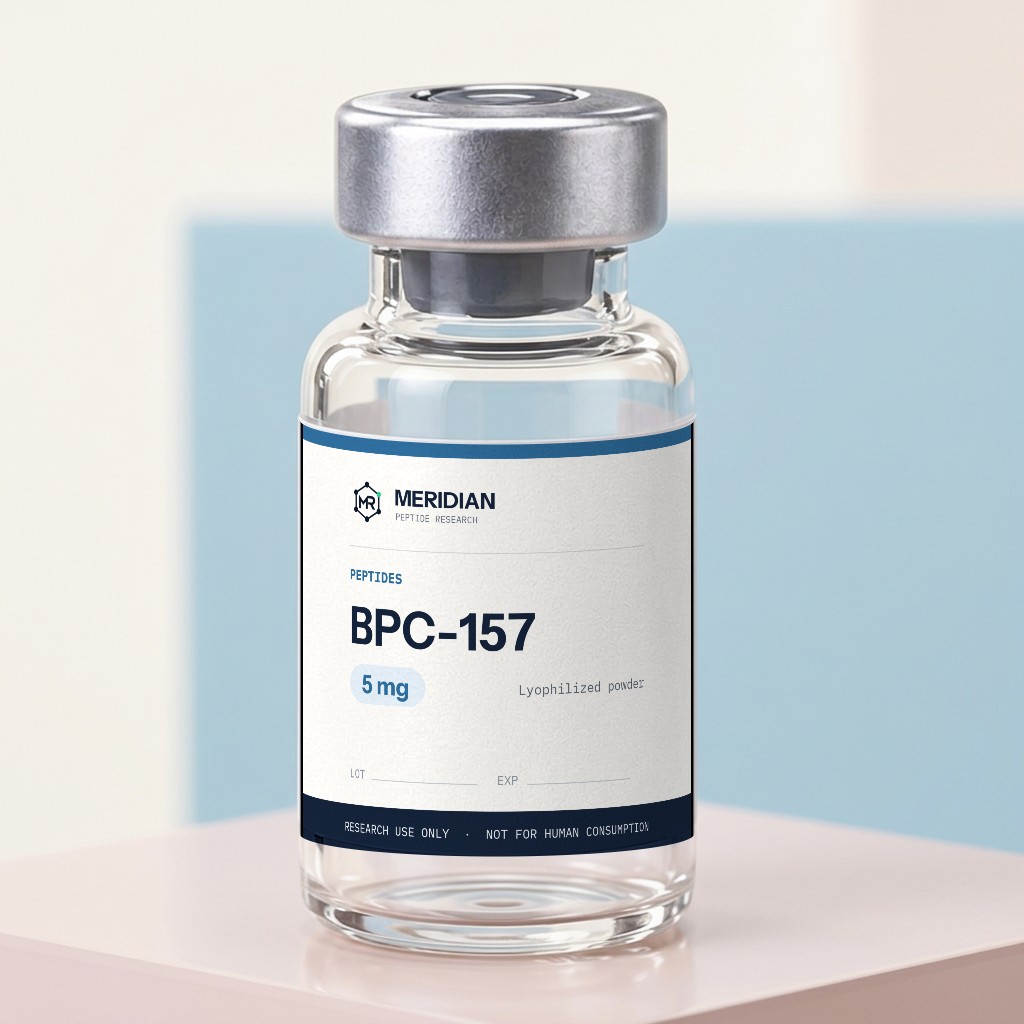
Representative image of the sealed vial. Label artwork and fill volume may vary by lot.
BPC-157
Body Protection Compound 157 · PL 14736 · Pentadecapeptide BPC 157
A synthetic 15-residue peptide derived from a sequence reported in human gastric juice protein, supplied as a lyophilized powder for in vitro and preclinical laboratory work.
- Documentation is lot-specific; request the record for the lot in stock
- Analytical methods and their limits are described on the testing page
- Lot lookup returns a result only where a signed report is held
- Supplied as a sealed vial for laboratory research use only
This material is supplied strictly for laboratory research. It is not a drug, food, cosmetic, or medical device, and it is not for human or veterinary consumption, diagnostic, or therapeutic use.
Overview
- Classification
- Synthetic pentadecapeptide
- Sequence
- Gly-Glu-Pro-Pro-Pro-Gly-Lys-Pro-Ala-Asp-Asp-Ala-Gly-Leu-Val
- Molecular formula
- C62H98N16O22
- Molecular weight
- 1419.5 g/mol (free acid)
- CAS number
- 137525-51-0
- Physical form
- White to off-white lyophilized powder
Research background
BPC-157 is a synthetic peptide corresponding to a fragment of a protein originally isolated from gastric juice. Interest in the sequence began in the 1990s in the laboratory of Predrag Sikiric at the University of Zagreb, whose group characterized it as unusually stable in gastric acid compared with many short peptides — a property that made it convenient to administer in rodent protocols without the degradation seen with less stable sequences. Essentially the entire published record on this compound comes from rodent and in vitro work; there is no substantial controlled human literature.
The largest cluster of published studies examined tissue injury models in rats. Reports from the Zagreb group and collaborators described accelerated closure in experimentally transected Achilles tendon, medial collateral ligament, and muscle-crush models, and reduced lesion area in ethanol- and NSAID-induced gastric injury models. In several of those papers the authors measured biomechanical endpoints such as load-to-failure in the healing tendon, and histological endpoints such as fibroblast density and collagen organization, rather than surrogate markers alone. A commonly cited example is Krivic et al. (2006), which reported improved functional and biomechanical recovery in a rat Achilles transection model.
A second line of investigation concerned vascular and angiogenic mechanisms. Chang et al. (2011) reported increased expression of VEGF receptor 2 and downstream signalling in cultured tendon fibroblasts exposed to the peptide, and several rodent papers described the appearance of collateral vessels around an occluded segment in ischemia models. Related work has been interpreted through nitric oxide pathway involvement, based on experiments in which L-NAME and L-arginine co-treatment modified the observed rodent outcomes. These are mechanistic hypotheses generated in animal and cell systems, not established pathways.
A third area concerns the gastrointestinal tract and its neural connections, where studies described changes in mucosal integrity and in dopamine- and serotonin-system readouts in rats. This work is exploratory and has been discussed in the literature as preliminary.
The principal limitation of the BPC-157 record is its concentration in a small number of laboratories. Independent replication outside the originating group is limited, several papers report large effect sizes in small-n animal cohorts, and reporting of blinding and randomization varies. Pharmacokinetic characterization is sparse, and stability data across formulations and solvents are not well standardized in the published literature. A 2022 review by Seiwerth and colleagues summarized the preclinical body of work while also noting the absence of completed controlled clinical trials. Investigators designing new experiments should treat published rodent findings as hypothesis-generating and include appropriate vehicle controls, blinded outcome assessment, and independent analytical confirmation of the material used.
Analytical specifications
| Purity method | Reverse-phase HPLC, reported per lot on the COA |
|---|---|
| Identity method | Mass spectrometry against the theoretical mass |
| Endotoxin | LAL screening; result appears on the lot certificate where the assay has been run |
| Appearance | Visual inspection of cake integrity and vial seal |
| Counter-ion | Trifluoroacetate salt unless the lot COA states otherwise |
Measured values are lot-specific and appear on that lot's certificate of analysis, not on this page.
Laboratory handling and storage
- Store sealed vials of lyophilized material at -20 °C, protected from light and moisture. Short excursions to ambient temperature during shipping are expected and are accounted for in packaging.
- Allow vials to reach room temperature before opening to avoid condensation drawing moisture into the cake.
- Reconstitute in the solvent appropriate to the assay. Bacteriostatic water and sterile water are both used at the bench; benzyl-alcohol-containing diluents are not suitable for every cell-based assay.
- Avoid repeated freeze-thaw cycles of reconstituted solution. Aliquot into single-use volumes where the protocol allows.
- Record lot number and reconstitution date on every aliquot so that results can be traced back to the certificate of analysis.
Certificate of analysis
No certificate is published on this page. Documents are lot-specific, and posting a report that does not match the vial you receive would be worse than posting nothing. Request the certificate for the lot currently in stock, or read how our testing program works and what each method does not detect.
References
- 1.Krivic A, et al. Modulation of early functional recovery of Achilles tendon to bone unit after transection by BPC 157 and methylprednisolone. Inflammation Research, 2008.
- 2.Chang C-H, et al. The promoting effect of pentadecapeptide BPC 157 on tendon healing involves tendon outgrowth, cell survival, and cell migration. Journal of Applied Physiology, 2011.
- 3.Seiwerth S, et al. BPC 157 and standard angiogenic growth factors. Gastrointestinal tract healing, lessons from tendon, ligament, muscle and bone healing. Current Pharmaceutical Design, 2018.
- 4.Sikiric P, et al. Stable gastric pentadecapeptide BPC 157: novel therapy in gastrointestinal tract. Current Pharmaceutical Design, 2011.
Frequently asked
What does the HPLC purity figure on the certificate cover?
It reports the percentage of total peak area attributable to the main peak under the stated chromatographic conditions. It does not quantify residual solvent, water content, counter-ion mass, or endotoxin — those are separate determinations.
Is the peptide supplied as a salt?
Solid-phase synthesis and RP-HPLC purification normally leave the peptide as a trifluoroacetate salt. Net peptide content is therefore lower than the gross vial mass, which matters when preparing gravimetric standards.
Which solvent should be used for reconstitution?
That depends on the assay. The peptide is water-soluble; laboratories commonly use sterile or bacteriostatic water. Preservative-containing diluents are avoided in assays where benzyl alcohol interferes.
Can a certificate of analysis be supplied before purchase?
Yes. Contact us with the compound and size and we will send the certificate for the lot currently in stock.